Sarina Langer is a dark fantasy author of both epic and urban paranormal novels. Her characters knew she's queer (demi and pan) and has ADHD before she did (and they didn't say *anything* to her!).
She’s as obsessed with books and stationery now as she was as a child, when she drowned her box of colour pencils in water so they wouldn’t die and scribbled her first stories on corridor walls.
(‘A first sign of things to come’, according to her mother. ‘Normal toddler behaviour’, according to Sarina.)
In her free time, she reads whenever she can, plays video games, and obsesses over mythology and languages.
She has a weakness for books on writing and pretty words. (Specificity, anyone? Or perhaps nebulous?)
Sarina lives with her partner in the south of England.
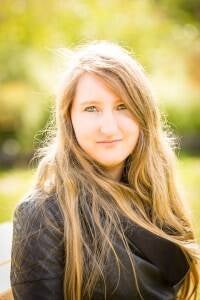
Image Description: A woman with dark blonde hair and pale skin is illuminated by bright, overhead sun. Blurred greenery is behind her.
Credit: c/o Sarina Langer
Q&A with Sarina Langer
Introduction
Q: Please introduce yourself! Share your name, pronouns, and something fun, interesting, curious, or important (take your pick) about yourself that you would like our audience to know about you.
A: Hi, everyone! I’m Sarina, she/her, and I’m a big nerd for languages, video games, and Egyptian mythology!
Q: What genre or format do you write in? (for example: romance, fantasy, short stories, poetry, etc.)
A: Everything I write fits somewhere along fantasy. I’ve written epic fantasy the most, but I’ve also published paranormal urban fantasy. My books often have a slow-burn romantic sub plot, but it’s never the focus. All of my books lean on the darker side, though the Chaos of Esta Anderson series is cosy, too!
Q: Who do you write for? Who is your audience, and are you seeking to reach a particular type of reader with your work? Why?
A: Growing up, I didn’t really see any queer representation in media, definitely no positive representation. It took me ages to realise I was queer myself because it just wasn’t talked about when I was growing up. I like to joke that Beguiled by Night by Nicole Eigener turned me gay, but really it just helped me understand myself a lot better - this was a few years ago, when I was already in my 30s. I write for everyone who wants and/or needs to see themselves represented in books like I needed to see myself.
Q: Where do you get your inspiration as a writer?
A: Most of it just happens while I write. Inspiration is like trying to remember that dream you had last night–the more you try to force it, the more it’ll evaporate. I’ve found writing by hand to be extremely helpful when I’m stuck, though. I’ll start with something like, ‘Right, so in this scene this needs to happen, but how?’ And then I keep writing until I know.
Q: Similarly, why pursue being an indie author? What is your goal?
A: Because I’m a control freak. While I don’t want to say that I’d never go the trad route under any circumstances, I’d probably want to have a little too much say in things like my cover etc for most agents and publishers. The ultimate goal is to be a full-time writer, but that’s hard to pull off, so I’ll also be happy if my books just reach the people who need them.
Q: What tricks do you use to get out of writer’s block?
A: I always think this’ll be controversial, but I don’t believe in writer’s block. If you feel like you just can’t get the words down, there’s usually something else going on. Maybe you’re burned out and need a break. Maybe the idea of people reading your book scares you. Maybe you’re worried no one will like it. Maybe you’re exhausted or stressed for reasons that have nothing to do with writing, like a family matter or your job situation. Blaming some invisible barrier won’t help you address the real issue, it just shifts the fault onto something you can’t do anything about.
Q: How do you fit into the LGBTQIA2S+ community?
A: I’m proudly demisexual first and pansexual second.
Q: Does being part of the LGBTQIA2S+ community affect the content you write? Does it affect the audience you try to reach?
A: It does now that I know! My books have always been inclusive, but now that I understand my own sexuality a lot better, I can write the representation with purpose. It’s always meant a lot to me when readers could see themselves in my characters and maybe even find some comfort in them, but now that’s the goal.
Q: What do you do to hone your craft as a writer? Are there any ways it might differ from other writers who don’t have your set of experiences?
A: Nothing hones your craft like writing, reading, and learning from others. You won’t become a better writer if you don’t write or read, but ideally, do both. Presumably, if you want to write a book, it’s because you love books, and you can learn so much by reading other people’s writing. I also love a good craft book. You don’t need to take on 100% of the advice or tips you read–everyone’s process is different–but you can still learn from the bits that resonate with you.
On Representation
Q: Do you wish you could read more books with LGBTQIA2S+ characters? Are there certain types of Queer folx you wish you saw more of in the books you read? Do you wish there was more diversity in the types of stories told? Overall, how do you think we are doing when it comes to LGBTQIA2S+ representation in literature?
A: Always! My heart always does a little jiggle whenever I see ace or demi representation in books, but we definitely need more, and we need it done well so everyone understands that an absence of sexual attraction is not the same thing as a preference to wait. I’d also love to see more wlw stories. So often, queer representation seems to equal mlm, but then maybe I’m just not looking in the right places.
Q: What does Queer representation in literature mean to you? Is it important to you? Does it affect culture - or is it a side effect? What are your thoughts in this area?
A: As someone who might have questioned herself MUCH sooner if she’d seen some representation earlier, queer representation means everything to me. It might be the only way some of us realise that we’re part of this community. It might be the only safe way some readers can engage with it.
Anything can affect culture if we get loud enough, representation included, but Culture is a big concept. It takes more than a handful of people when we’re talking about such a big scale. Representation is a side effect, too. The fact that so many of us write to represent because we didn’t see it growing up proves that.
Q: Do you come across bad Queer representation in the books you read? How does it make you feel? How do you think we can do better when representing the disability community in literature?
A: Not too often, fortunately, but then I’m a slow reader. All bad representation is disappointing. Writers have a responsibility to show up by doing their research. Don’t write about things you don’t understand if you’re not prepared to learn. Don’t just make stuff up when you don’t know. Some stories just aren’t yours to tell–there’s a big difference between having a gay side character and writing about a gay character’s struggles with coming out when you yourself haven’t had that experience. That doesn’t mean you can’t write a gay main character if you’re a straight woman (as an example), but really consider if you’re the best person to make his character development about his struggles of coming out when you yourself have never been in that position. A brief mention is one thing, but if his character development depends on it? There are writers with personal experience who can tell that story. Respect and intention is everything, and you can’t beat own-voice representation.
On Advice
Q: What advice would you give to new writers?
A: Don’t overthink it. Easier said than done, I know. But if you worry about whether your plot really does answer every single problem that might come up and what the reviews will be like before you’ve even written the first chapter, you’ll never get it done. Your first draft is just that–a first draft. You can iron out the creases once the story is done, but you kinda do need to write it to do that first. You can’t edit a book that’s not there. You don’t need to share it with everyone right away, and you don’t even need to ever publish your book if you’d rather not. Writing a book and self-publishing isn’t easy. There’s a lot that goes into it, and it’s not for everyone. It’s fine to write for yourself and no one else. But while you’re still trying to get the story down, enjoy the process–creation is a wild, beautiful, and living thing, after all.
Q: What was the best piece of advice given to you as a writer, or even as a Queer writer?
A: Someone once told me (many years ago, when I was gearing up to work on my first book) to never go with your very first idea, or even your second or your third. Go with your tenth. If a scene or a solution to a plot problem is obvious to you, it’ll be obvious to your reader, too, but if you didn’t see it coming, neither will they.
About Your Work
Q: What do you love most about crafting a new work?
A: The joy of discovering a new story. There’s so much excitement, so many possibilities, in the initial plotting and planning.
Q: Would you like to share anything about your current work-in-progress?
A: Book 15/Esta 4 has recently gone to my editor, and I’m really looking forward to their notes! I’m also building a new epic fantasy world and getting to know the characters, which has been a lot of fun.
Q: Where can readers find your work? Please share links and pertinent information.
A: The best place to start looking is my website: https://sarinalanger.com/
You can find all of my books on there, and you can buy them all directly via my website, too. Otherwise, you can find all my current links on sarinalangerauthor.carrd.co
Final Thoughts
Q: Thank you for sharing your thoughts, today. Any final words?
A: Thank you so much for having me! :)
Add comment
Comments