Emily Ava Gillespie (they/she) is an author, disability activist, and professional daydreamer. They won the 2021 Dr. James Jamieson Influential Alumni Award from Nipissing University. Gillespie has a BA in Gender Equality and Social Justice and an MA in Critical Disability Studies. They earned a certificate in Creative Writing from Concordia University.
They have volunteered and worked in the disability community as an activist, researcher, peer support and facilitator for fifteen years. Gillespie is also an author and performance artist. Her work explores themes of memory, identity and mental health journeys. They enjoy working in community spaces and examining individual and collective experiences.
Dancing with Ghosts (Leaping Lion Books, 2017) is her first novel. Their poetry and short-stories can be found in several journals and anthologies. She co-edited Mighty: an Anthology of Disabled Superheroes by Renaissance Press published fall 2023. Her most recent novel is titled Wait With Me and was released in 2025.
Introductions
Q: Please introduce yourself! Share your name, pronouns, and something fun, interesting, curious, or important (take your pick) about yourself that you would like your audience to know.
A: Emily Ava Gillespie - I have a learning disability, and I struggled to read and write, and now my greatest love in life is storytelling.
Q: What genre or format do you write in? (for example: romance, fantasy, short stories, poetry, etc.)
A: Literary fiction, poetry, short stories
Q: Who do you write for? Who is your audience, and are you seeking to reach a particular type of reader with your work? Why?
A: I write for young adults, 16- 35 is my target age. I am particularly interested in reaching the disability and activist community. While the younger crowd is my primary audience I’ve found that older adults, especially those who support young people can relate to the narratives and use them for their advocacy work
Q: When did you decide you wanted to write?
A: I was born with my tongue tied. It was cut in a surgery when I was a child so that I could tell stories. In grade two we had something at our school called Author’s Day. Authors from the community came and read to us. I knew then that I wanted to be an author. I never looked up to movie and rock stars, it was always the story tellers that I personally admired.
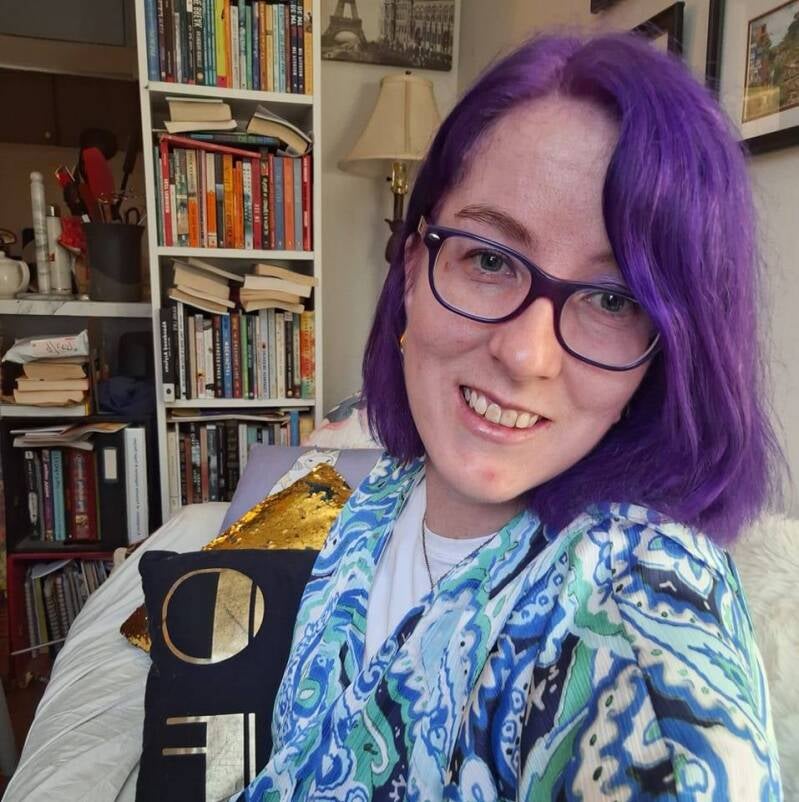
Image Description: The author, Emily Ava Gillespie, looks into the camera with a smile on their face. She has shoulder-length, purple hair, dark-rimmed glasses, and a peachy complexion. They are wearing a cheerful-looking shirt with swirling shades of blue, teal, and white. Gillespie is seated in front of a slender bookshelf overflowing with books that have brightly colored spines.
Credit: c/o Emily Ava Gillespie
Q: What got you interested in the world of writing originally?
A: I always fall in love with characters and feel their stories deeply. My first friend from a book was Anne Shirley, and some of my dearest friends in life live on paper.
Q: There are so many possible avenues to take. Why write?
A: I identify as a storyteller not a writer, writing was just the most accessible and affordable means of storytelling for me. I view my first novel, “Dancing with Ghosts” as a screenplay in my head. I would love for “Wait With Me” to be turned into a miniseries. Many of the scenes are quite visual and I think Jade the main character could be captured well on camera.
Q: Similarly, why pursue being an indie author? What is your goal?
A: My goal is to tell stories, about mental health, grief, love friendship, exploration and, basically the human experience. I’ve been gifted words, and I want to share my gift for storytelling and unique perspectives with the world. I think each of us who were given creative gifts from the universe owe it to each other to make the world a bit better place by sharing our creativity, this is part of what makes us human.
Q: Do you consider yourself a minority? If so, would you be willing to share the ways in which you are?
A: I’m straight up privileged. I’m a Canada citizen, white, and educated. I am also a minority. I am autistic, have a learning disability, chronic pain, trauma, am a sexual assault survivor and lived through a deadly mental illness.
Q: Does this impact what you write about? If so, why and how?
A: Oh definitely. I tell stories of anger, resistance, struggle, and most of all hope in this. As explored earlier in this interview Wait With Me is about my experience trying to get lifesaving mental health care in a situation that was almost fatal for me. It is a story of hope and survival. I chose to write this incredibly vulnerable story, because I think the cracks in the system are important to expose especially because I had the access to platforms for storytelling and wanted to use my privilege for good. I viewed this as my activist social responsibility. When I was in the hospital and almost died, staying alive was my final act of protest. I have framed on my desk a card that says “existence is resistance” and I believe that in my bones. I believe that we each have to do our part to move society forward for the future generations. I am passionate about having conversations to make the mental health care system better.
Q: What do you wish you found more of in books today? Why?
A: I have read some amazing indie books, and my main wish is that they had wider reach. I know the opposite of indie, but great books are only read by a handful of people and don’t get the recognition they deserve because they lack marketing budgets.
Q: What does representation in literature mean to you? Is it important to you? How so?
A: Representation means including diverse voices and stories and the opportunity to see myself reflected back in the characters. It is important to me, that’s why my two indie novels were about disabled main characters. I recently co-edited an anthology, “Mighty: An Anthology of Disabled Superheroes” disabled voices matter, and realistic representation that challenges stigma and stereotypes.
Q: How do you think representation in literature affects culture? Does it?
A: Wow, getting me thinking. In “Wait with Me” I show some of the flaws of the emergency mental health system. Even in small ways, I see people using my text to talk about the barriers they’ve experienced in the health care system. I hope that this gets used as an advocacy tool. Also, in sitting and “waiting” with the main character Jade while she is in crisis I am hoping that people who might not otherwise have depth of empathy or understanding towards people in mental health crisis may experience this. I’ understand that empathy can be taught and deepened through fiction and reading.
Q: Does representation play a role in what or how you write? Please talk about why or why not.
A: I write what I know, as a queer disabled person, I am drawn towards telling queer and disabled stories. I also want to write things I haven’t read before, so lack of accurate representation, especially around narratives where the main character has BPD definitely inspires me.
On Representation
Q: Do you wish you could read more books with disabled or chronically ill characters? Do you wish there was more diversity in the types of stories told? Overall, how do you think we are doing when it comes to disability representation in literature?
A: That’s a great question, and one I can only answer in part. I love reading memoirs about disability, especially ones that pertain to my life. I feel include and scene, and sometimes hopeful about a way forward. I get to laugh with the author about the challenges of disability life. I mourn with them and also feel disabled joy.
However, in terms of literature, I read all kinds of stuff from mystery to romance to literary fiction. I don’t specifically seek out disabled main characters, but if I’m browsing at the library and see a book I’m already interested in and read the cover, and it mentions disability I’m more likely to add it to my TBR pile.
I want to challenge the idea that disabled people are only interested in disabled stories. Sometimes being disabled is exhausting, it’s part of my identity, but not the entire thing, and I read for education, pleasure, entertainment and fun. I love stories where my identity is included, but I also want to learn about other people, especially other marginalized folks from around the world.
I know disabled people are missing as main characters or are reduced to stereotypes, especially in certain genres. This is why I agreed to co-edit Mighty, so that disabled superhero stories could be told by disabled folks and have representation as heroes.
As per how we are doing overall with disabled representation in literature, I’m really unsure. That requires a detailed analysis of media representation, and I know a few people who are currently doing PhD’s on that, one day I will talk to my pals who are doing PhD’s and writing academic journals about their findings.
I will tell you as a final note, that when I was searching for comparables for Wait With Me, I couldn’t find anything similar and really had to reach. There are many stories set in psychiatric hospitals, but not about the struggles to get care, and then community care and friendship networks.
Q: What does disability representation in literature mean to you? Is it important to you? Does it affect culture - or is it a side effect? What are your thoughts in this area?
A: Another great thought-provoking questing. I took a few classes on media in university, specifically a class on Queer Media. Yes, a basic answer is media representation does make its way into culture, that’s why how we represent queer folks, disabled folks and other minorities really matters.
How we represent and talk about disability in media might be people’s first introduction to a certain disability. There is a lot of stigma around mental illness in media, however, media is also a space where stigma begins to get pulled a part depending on representation and the conversations said representation provokes. It’s undebatable that Borderline Personality Disorder (BPD) has a bad public image. In Wait with Me I wanted to humanize BPD through Jade, who is both imperfect, trying her best and deeply loved by her friends and an important part of her community. I want Wait With Me, to make its way into book clubs and classrooms as a thought-provoking tool that can be used to challenge how we treat mentally ill folks in crisis.
People with BPD, myself included are often viewed as throwaways by society. In crisis I’ve been told by medical professionals that statistically BPD folks have heavy suicide ideation and are suicidal and that they couldn’t help me because of my diagnosis, I basically was not worth the resources.
I’m here to say, through Jade and Waith With Me that our lives are important, no matter how many resources and hospital trips it takes. Folks with BPD are often basically viewed as “fucked” in the medical system, they are revolving door patience, can’t be helped and are a burden on the system. I’m here to challenge this and offer a story of hope and survival through Jade. I think stories of hope for folks with BPD and other serious mental illnesses are lacking though I haven’t done a lit review. Here’s my contribution to progressive disability representation in literature.
Q: Does disability representation play a role in what or how you write? Please talk about why or why not.
A: I don’t think about representation so much as experiences disabled folks have. As per this question I want to acknowledged that having lots of disability stories is important so that characters don’t become a monolithic experience. What I mean is that Jade, my MC is coded as being autistic, however, as we know all autistic people are different, that’s why it’s called a “spectrum.” If the public gets to know different autistic characters in media, then we won’t always be referring to Sheldon, from The Big Bang Theory as the key example of autism in media.
Q: Do you come across bad disability representation in the books you read? How does it make you feel? How do you think we can do better when representing the disability community in literature?
A: I’m lucky, in that I have a rather curated reading list, so I generally don’t come across bad disability representation. I have multiple disabilities, and it goes without saying that I don’t have every disability. Therefore, I want to acknowledge that I don’t necessarily know when I’m consuming bad media representation if it’s a disability, I’m not aware of. Authors have a responsibility to create accurate and compassionate representations of
disability because they may be introducing their audience to that disability for the first time.
Q: Do you have any further thoughts on disability representation you would like to add?
A: Please fund disabled authors. When we produce great work, give us grants, give us publishing deals, buy our books, give us awards, invite us to festivals, hand us the mic stop making us fight for a space at the table, and stop leaving us out of diversity conversations. If I can make money off my writing, I can therefore afford more time to spend writing and create more books it’s simple math.
I want to know that my novels go beyond my network into the larger world, and that my stories can be used as an activist conversation tool as intended. Also, I love hearing from my readers, send me a message, leave a review, every piece of encouragement goes a long way for indie authors.
When I’m spending a rare free Saturday writing instead of doing another activity, I want to have hope that I’m spending my life wisely creating works and worlds that will help and inspire others.
On Advice
Q: What do you do to hone your craft?
A: I read all the time, authors with similar style, but also different voices. I also attend writing classes and workshops when time allows.
Q: What tricks do you use to get out of writer’s block?
A: I don’t force the writing to come. I walk away and work on something new. If a subject is too raw or vulnerable to write about, I give myself permission to not touch certain topics.
Q: Would you mind telling us about your writing process?
A: It has been different for each work. I create rough outlines for the book and draft chapter outlines. I also have character sketches. I give myself some freedom to see the mood of the chapter as I go. Most of the writing, especially in Wait With Me actually happened in the re-writes. It is a character driven story, and I got to work on getting the character across, and the unique dialogue for each in the re-write process when I looked at the page and went, nahh that’s not quite Jade and then had the chance to go deeper with it.
Q: Do you have any other writing “hacks” that other writers might benefit from?
A: Read often and all sorts of texts. Don’t pressure yourself to be perfect on the first draft, the art is in the re-writes. Remember who you are and aren’t writing for. Recently, I was chatting with someone who said they didn’t like Nirvana. How can you not like Nirvana I thought and that reminded me that not every artist even as amazing as Kurt is for everyone. Therefore, I’m okay if people don’t like me. Some people will love my writing, and others will think it’s garbage, and that’s okay, it’s not for them.
Another hack is to take creative breaks, have a shower, go to a poetry slam, go for a walk and listen to music, keep something to write on you at all times. Lots of writing doesn’t happen sitting Infront of a computer but inspired out in the world. If you are doing a character driven piece, I love taking the time to intimately get to know my characters and take them out on dates and spend time with them like they are friends.
Q: Where do you get your inspiration?
A: I’m autistic, and sometimes I honestly feel like an alien trying to make sense of the world around me. Even though I write in fiction, every day I am surrounded by stories, that are absorbed into my pours. With creativity, I get to try and make sense of the world and craft the stories this alien wants to tell.
The direct inspiration for Wait With Me was from my experiences as an autistic person with borderline personality disorder trying to access emergency medical care. I was furious about my experiences and also recognized my privilege as an educated white person trying to navigate the system. I wanted the reader to imagine the barriers that someone without Jade’s privilege might have. There are so many narratives around mental health that suggest that there is help if one is just brave and reaches out. I wanted to untangle what reaching out could be like in moments of crisis. I also wanted to explore the support network that the medical system assumes people have. What if I like my fellow millennials don’t have a nuclear family, romantic partner or traditional support network, what does that look like?
Q: What advice would you give to new writers?
A: Keep writing, just keep writing. It may take years to get published if ever, but there’s always a way forward, from zines, anthologies and self-published novels, there’s a way forward. Also, don’t let people pigeon-hole you, it’s okay to change what you write about over your career.
Q: What do you wish someone had told you when you were finding your path?
A: Some mentors and creatives will love your work, and others won’t. It’s not necessarily about the value or quality of the work, but if it speaks to them. Keep going and find your audience and the people you speak to.
About Your Work
Q: Would you like to share anything about your current work in progress?
A: I am writing a memoir on how I ended up with the desire to travel the world, while having a major mental illness that at times stops me from leaving the house. The memoir, Dead Girls Don’t Get Ass Tattoos explores grief over my dad’s dementia, navigating the world as a disabled, female, sexual assault survivor all while still having the desire to explore and a nuanced, bittersweet desire for life and joy.
Q: Do you have any work already out there that you would like to talk about? If so, please tell us about the project, why you wrote it, and what you hope readers will take from it.
A: “Dancing with Ghosts”, get it from your local library. It explores mental health and domestic violence and the barriers to leaving.
“Mighty: An Anthology of Disabled Superheroes” (2023 Renaissance Press) it is an anthology with 14 stories written by disabled authors. In the calls for submissions we said, “no inspiration porn.” We are hoping that readers feel represented as heroes in these stories, versus being reduced to architypes. Get it at Renaissance Press website, Amazon or your local indie bookstore
Q: Where can readers find your work? Please share links and pertinent information.
A: Dancing with Ghosts- please get it from the library
Mighty- e-reader and print on Amazon https://www.amazon.ca/Mighty-Anthology-Superheroes-Emily-Gillespie-ebook/dp/B0D46NMVW8
Wait with Me e-reader and print on Amazon https://www.amazon.ca/Wait-Me-Emily-Ava-Gillespie-ebook/dp/B0F9477BJD\
If you want to see more of my work, and leave reviews, please see my Goodreads page
https://www.goodreads.com/book/show/233983780-wait-with-me
Also, please request your local library gets copies of my books. I love being included in libraries, and think they are extremely important social spaces.
Final Thoughts
Q: What would you like to share or say to the Underground Bookshelf audience that hasn’t already been brought up?
A: I want to congratulate anyone who has a book out there, even if you’ve only sold a few copies. Writing a book, getting it ready to publish, and marketing are all huge and timely steps. Marketing is hard, and lack of readers and awards has more to do with marketing dollars then merit. Big congrats to all my fellow published authors and aspiring authors.
Q: Thank you for sharing your thoughts, today. Any final words?
A: Thanks so much for having me. If you are a writer, keep at it, your stories matter. We indie authors survive on free marketing, sharing posts and reviews, so please do what you can to support us. Marketing on numerous social media platforms is timely, so please boost us and promote us any way you are able.
Thank you for caring, thanks for reading diverse stories. If you’d like to talk to me about my work, feel free to send me a message.
Add comment
Comments